
Solo practice: drills you can run alone
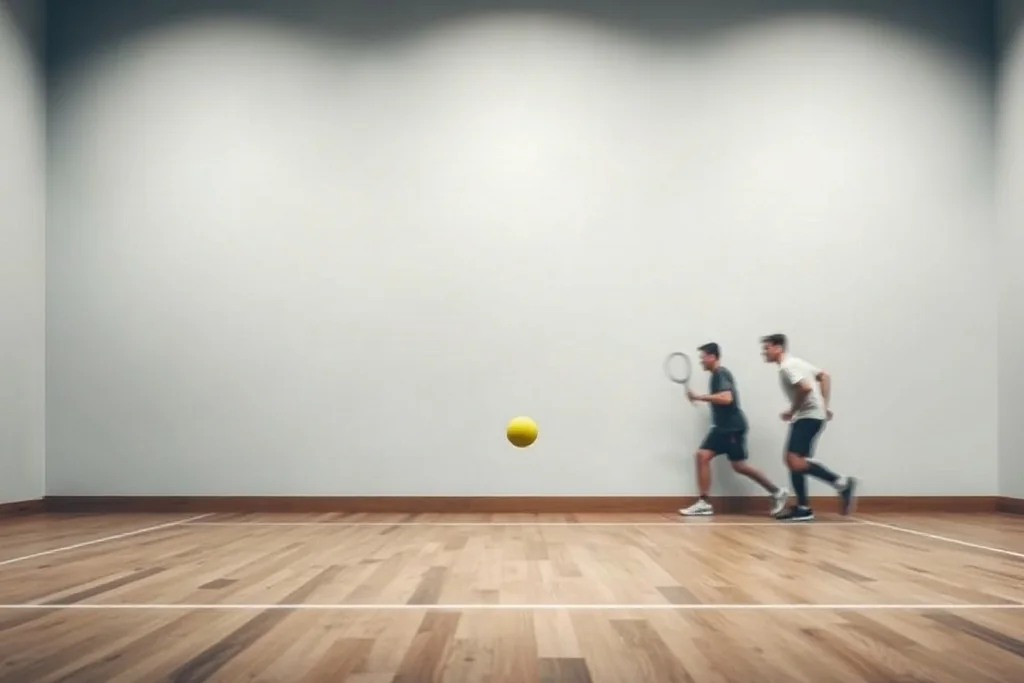
You do not need a partner to improve at squash or racketball. Some of the most effective practice is done alone on court, hitting ball after ball against the wall and feeling the difference each repetition makes.
This article describes simple solo drills that build touch, fitness and consistency. They suit adult players with limited time who want to make progress without depending on finding a partner for every session.
Why solo practice works
Solo practice gives you more repetitions in ten minutes than most matches give you in an hour. Because you control every shot, you can feel each hit, adjust immediately and focus on one specific skill without the distraction of an opponent.
It also fits a busy adult schedule. Ten focused minutes before a club night or on a quiet afternoon is easy to slot in, and the steady repetition builds habits that carry straight over into your matches.
Straight drives for length
The foundation drill is the straight drive. Stand near the middle, drop the ball and hit it straight down the wall so it lands deep and comes back to you. Repeat, aiming to keep the ball tight to the wall and deep in the back corner.
This single drill builds the most valuable shot in club squash. If you can hit straight drives consistently for a minute without missing, you already have the length that wins points at club level.
Cross-court repetition
Once straight drives feel steady, alternate a straight drive with a cross-court shot. This trains you to control the ball to both sides of the court and to move your feet to adjust for each shot.
Cross-court practice also builds the width that stretches opponents in a match. Ten minutes alternating straight and cross will sharpen both your aim and your footwork more than a casual rally would.
Front-court touch and the drop
To develop touch, stand closer to the front wall and gently drop the ball, trying to make it die softly in the front corner. The goal is control, not power — a good drop barely reaches the front wall and comes back to you.
This drill teaches the feel needed for the drop shot, which is one of the most useful attacking shots at club level. Repeated gentle practice is the only way to learn the delicate touch the shot requires.
Solo fitness intervals
For fitness, use the court as a circuit. Hit a ball, move to a corner, hit another, move back, and keep going for a set period. The repeated movement with short rests mirrors the demands of a real match.
You can also run simple ghosting patterns — moving to each corner on your own — to build the stop-start stamina squash needs. It is a tough but effective way to train when no partner is available.
Building a ten-minute routine
A simple solo session might be three minutes of straight drives, three of cross-courts, two of drop shots and two of movement intervals. That covers length, width, touch and fitness in a single short workout.
Keep the routine fixed so you do not have to plan each time, and repeat it whenever a court is free. Consistency matters far more than variety, and a familiar routine is easy to stick to week after week.
Fitting practice into a busy week
Solo practice is ideal for adults with limited time because it needs no partner and no long booking. Ten minutes before a club night or after a casual game is enough to make a real difference.
The players who improve fastest are usually the ones who use spare court time rather than waiting for the perfect session. A few focused minutes a week adds up to a noticeably better game by the end of a season.
Tracking your progress
A simple way to stay motivated is to count how many consecutive shots you can keep going in each drill. When that number rises, your control is improving, even if a match result does not show it yet.
Solo practice rewards patience. The gains are quiet but real, and they show up in matches as steadier length, better touch and the ability to keep a rally alive long enough for the opponent to make the error first.
Solo drills you can do alone
Five drills that need only a court, a racket and a ball:
- Straight drives down the wall for length and consistency.
- Straight and cross-court alternation for width and footwork.
- Gentle drops to the front corner for touch and control.
- Ghosting or interval movement for match-style fitness.
- A fixed ten-minute routine repeated whenever a court is free.
A ten-minute solo session
A simple plan you can repeat every week:
| Drill | Focus | Time |
|---|---|---|
| Straight drives | Length and control | 3 min |
| Cross-court drives | Width and footwork | 3 min |
| Drop shots | Touch and feel | 2 min |
| Movement intervals | Stamina and speed | 2 min |
Alone is enough to improve
You do not need a partner or a long session to get better at squash and racketball. Ten focused minutes of solo drills builds length, touch and fitness — the three things that decide club matches. Use the court whenever it is free, keep the routine simple and let repetition do the work.
Read next
Warming up and cooling down for squash
A short, practical warm-up and cool-down routine that helps adult players avoid injury.
Hitting good length: the shot that wins matches
Why deep shots into the back corners decide club matches and how to practise hitting them.
Common squash injuries and how adults avoid them
Ankles, knees and eyes: the risks adult players face and the simple habits that reduce them.